Cane and rattan furniture: quality issues and what to check before you order and before packing
Cane and rattan furniture fails through what the eye cannot see at the factory: borer and mould from untreated or damp material, then broken or loose weave, webbing pulling out of its groove, and seats that sag. Make treatment a condition of the order, sample widely because hand weaving varies, and pack with a moisture plan so a dry shipment does not arrive mouldy.
How it is usually made: Rattan poles bent into frames, or solid wood frames, with cane webbing pressed into a groove and held by a spline, or hand-woven cane, rattan, seagrass or other natural fibre; joints are often bound with cane.
Put these in the purchase order
An inspector can only hold the factory to what is written down. Add your AQL, moisture limit and golden sample to every order as well.
| Specify | Why it matters |
|---|---|
| Treatment against borer and mould | The treatment method and a treatment or fumigation certificate as a condition of the order, not an afterthought. |
| Weave pattern and tension | An approved sample for pattern, tightness and colour; hand weaving varies more than machine work. |
| Webbing fixing | Pre-woven webbing set in a groove with a glued spline, and how the edges are finished. |
| Moisture limit and desiccant plan | Natural fibre sealed into a humid container grows mould. Put a moisture limit and a desiccant plan in the PO. |
| Frame material and joints | Rattan pole or solid wood, and how joints are fixed and bound. |
Defects to look for on a cane or rattan piece
Usual class by our default definitions: critical is unsafe or unshippable, major affects function, saleability or durability, minor is cosmetic. Your own defect list always overrides it.
| Defect | Usual class | Usual cause | How it is checked |
|---|---|---|---|
| Live borer or mould | Critical | Untreated or under-treated cane; fibre packed damp. | Look for frass, fresh exit holes, mould and musty smell; check the treatment certificate against the lot. |
| Seat weave or webbing gives way under load | Critical | Brittle or thin strands, webbing not glued into its groove. | Sit-test and press seats and backs on sampled pieces. |
| Broken, loose or missing strands | Major | Dry or brittle cane, rushed weaving. | Inspect every woven panel front and back. |
| Webbing pulling out of its groove | Major | Spline not glued or too small. | Press along the panel edges and check the spline. |
| Split or cracked rattan poles at bends | Major | Poles bent too tightly or without enough steaming. | Inspect bends and binding on frames. |
| Weave pattern or colour off the sample | Minor | Different weavers or fibre batches. | Compare pieces side by side and against the approved sample. |
Cane and rattan furniture we have inspected
Photos from our inspections and our anonymised sample inspection reports. Brand names, item numbers, labels and people are blurred.
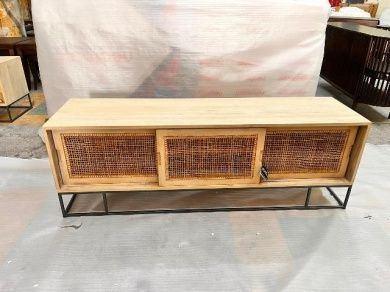
What to check during production, at inspection and before packing
During production
- Treatment of cane and fibre stock before weaving, with records.
- Moisture of frames and fibre before weaving and finishing.
- First woven panels against the approved sample.
At pre-shipment inspection
- Check the treatment certificate covers this lot; inspect for frass, holes and mould.
- Inspect every woven panel and sit-test seats on a wide sample.
- Check webbing edges, splines and binding.
- Compare weave and colour across pieces against the sample.
Before packing
- Pieces dry before packing; no plastic sealed tight around damp fibre.
- Desiccant in cartons and the container on humid routes.
- Woven panels protected so they cannot be pierced or crushed.
Moisture, finish and sampling
- Moisture: put a limit for your destination in the PO and have it read with a pin meter on sampled pieces. Wood shipped wet cracks after delivery. Targets by market are in the wood guide.
- Finish: approve a golden sample and hold every batch to it; finishes cured in humid weather can bloom in transit.
- Sampling: AQL 2.5 for major and 4.0 for minor defects at General Level II by default. The AQL calculator gives the sample size for your order.
- Hardware: count kits against the bill of materials; wrong or missing hardware turns a sound product into a return.
Rules that may apply to a cane or rattan piece
| Rule | When it applies |
|---|---|
| ISPM 15 | For any solid wood crates or pallets used to ship the goods. |
| Destination plant-health rules | Some countries inspect or require treatment of cane, rattan and natural-fibre goods on arrival. Check your import conditions. |
| UK fire safety | If cushions or upholstery are supplied. |
Cane and rattan furniture: questions
Why did my cane furniture arrive mouldy?
Natural fibre packed damp or sealed into a humid container. Check moisture before packing, use desiccant, and do not seal damp pieces in plastic.
What proof of treatment should I ask for?
A treatment or fumigation certificate for the lot, made a condition of the order, and an inspection for live borer and mould at pre-shipment.
Why does hand-woven cane need a larger sample?
Each weaver works slightly differently, so variation spreads across the lot. Inspecting more pieces catches it.
Related guides
- Dining chairs: Joint strength, corner blocks, wobble, seat height, colour matching across a set.
- Outdoor wooden furniture: Hardware that rusts, outdoor finish, water traps, folding mechanisms, cushions.
- Wooden sofas and armchairs: Frame joints, springs and webbing, foam, upholstery, fire labels.
- All furniture inspection guides
- Free furniture inspection checklist (PDF)
Have your cane or rattan piece order checked before you pay
Tell us the factory, the product and the date. We reply with scope and a fixed quote within 24 hours. A pre-shipment inspection starts at $249.
Talk to an inspector Pre-shipment inspection