Importing furniture from India to Spain
Spain is two climates in one country. Dry, heated and air-conditioned interiors inland pull water out of hardwood that shipped too wet; the humid Mediterranean coast and the sea leg into Valencia grow mould on anything finished in monsoon air. Here is what to control, what the regulations now require, and where the claims actually come from.
Based in Jodhpur since 2017 · Paid by buyers, never by factories · Reports in 24 hours
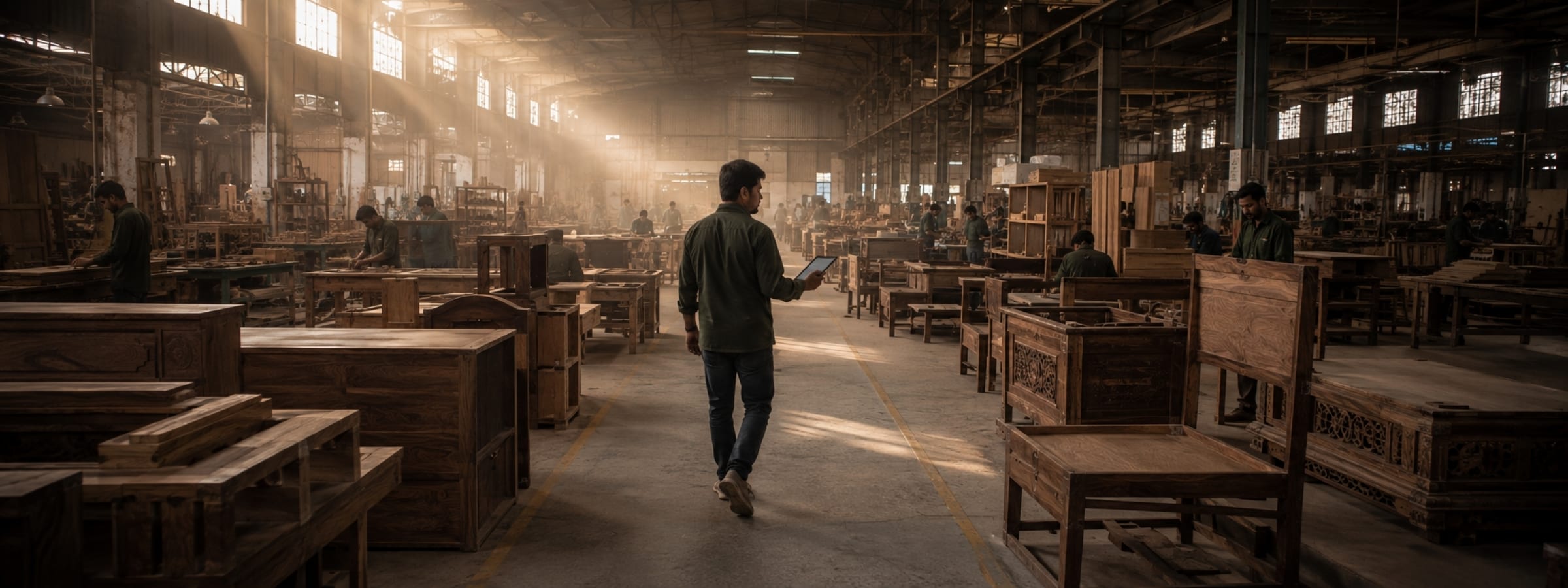
Two climates, one moisture problem
Furniture that is perfectly stable in Rajasthan can split in a heated Madrid apartment through winter, or arrive with bloomed finish after a humid crossing into Valencia. Nothing was faulty at the factory — the wood simply left India carrying more water than a dry Spanish interior will let it keep, on a route damp enough to punish a soft finish.
| Condition | What happens to the wood | Typical MC |
|---|---|---|
| Jodhpur workshop, pre-monsoon | Timber equilibrates to a warm, relatively humid environment. | 11–14% |
| Container in transit to the Med | Heat and trapped humidity; finish can bloom, moisture redistributes. | — |
| Spanish interior, heating or AC on | Inland and conditioned air is dry for months. Wood gives up moisture and shrinks. | 6–9% |
| Our shipping specification | Narrow the gap before shipment so shrinkage stays within tolerance. | 8–10% |
A tabletop that ships at 13% and settles at 7% in a heated Madrid flat loses volume across its width. That shows up as open joints, panel splits and cracked tops — usually four to eight weeks after delivery, which is precisely when it becomes a retail return rather than a shipping dispute. On the coast the same order can arrive with mould spotting or a clouded finish from the crossing. Between them, moisture is the single largest claim category we see on Spain-bound orders.
HOW WE CHECK — multiple pin-meter readings per item across tops, panels and rails, recorded individually rather than averaged, with the batch failed if readings sit outside the destination specification. Desiccant and finish cure are checked for the coastal route. Readings are photographed with the meter in frame.
Beyond moisture
Joints built for a different market
Spanish retail buyers test what they sell, and end customers return what wobbles. Undersized tenons, missing corner blocks and subcontracted assembly are invisible in photographs and obvious after a month of use.
A finish that didn't survive the crossing
Lacquer cured in monsoon humidity can bloom or cloud inside a hot container, and the humid Mediterranean sea leg raises the mould risk on natural fibres and unsealed timber. Coastal buyers reject on surface appearance readily.
Timber paperwork that was never checked
Species declarations and purchase records are often accepted on trust. Under EUDR the importer carries the liability for that trust, not the factory.
Consumer information not in Spanish
Spain expects consumer information, care instructions and assembly sheets in Castilian Spanish. A missing or English-only label is a retail rejection — and it is printed at the factory in Jodhpur, not fixed in Valencia.
What actually applies to a Spanish furniture importer
The compliance landscape moved significantly in 2026. Here is the honest version — including where the obligation sits with you rather than the factory.
EUDR — timber due diligence
Wooden furniture is in scope. As the party placing goods on the EU market you are the operator and carry primary liability. Requires plot geolocation, proof of legal production and a documented supply chain.
30 DEC 2026 · ALL SIZESSpanish-language labelling
Consumer information, care and safety instructions and assembly guides are expected in Castilian Spanish under Spanish consumer-protection rules. It is a retail and market-access requirement, decided at the point of printing — which is the factory.
PRINTED AT SOURCEEN furniture standards
Strength, durability and stability testing referenced to EN 1728, EN 12520 and EN 12521, plus EN 1022 for seating stability. Not a customs gate — but the basis on which Spanish retail buyers accept or reject.
CONTRACTUAL, NOT BORDERThere is no EUDR certification scheme, and no inspection company can certify your supplier as EUDR compliant. What exists is evidence, a risk assessment and a due diligence statement that you file. We collect and verify the evidence; the statement stays yours. Treat any vendor offering an EUDR certificate with caution.
India to Spain, and where inspection fits
Typical routing
- Jodhpur / Jaipur cluster to portROAD 1–2 DAYS
- Mundra or Nhava ShevaORIGIN PORT
- Sea transit to the Mediterranean~3–5 WEEKS
- Valencia or BarcelonaARRIVAL
- Algeciras transshipmentALTERNATIVE
Where we intervene
- Supplier verified before depositPRE-ORDER
- Production checked mid-runDUPRO
- Moisture & build at 80% packedPSI
- Count, condition, seal at stuffingLOADING
- Timber evidence file assembledEUDR
THE POINT — every one of those interventions happens before the container sails. Once it is at sea, your options narrow to a credit note negotiation with a supplier who has already been paid.
Published pricing, paid by you
We take no commission from factories. Prices in USD; EUR invoicing available on request.
Pre-Shipment Inspection
AQL 2.5 sampling to ISO 2859-1, moisture readings against Spanish destination spec, photographed report in 24 hours.
BookProtected Container
Pre-shipment inspection plus loading supervision, count verification, seal photographs and 12-hour reporting.
Protect my containerEUDR Evidence Review
Timber documentation audited on site, upstream tracing to yards and traders, indexed evidence file with an honest gap register.
See scopeSpanish importers ask
What moisture content should I specify for the Spanish market?
We recommend 8–10% for solid hardwood destined for Spanish interiors, verified with multiple readings per item rather than a batch average. Spain runs dry inland and in air-conditioned rooms, so wood shipped at 12–14% — normal for an unmanaged Indian workshop — shrinks once it settles, and that shrinkage is what opens joints and splits tops. On the coast we also check finish cure and desiccant against the humid crossing.
Do I need EUDR compliance if I am a small importer?
Everyone importing wooden furniture comes into scope on 30 December 2026. The general deferral to 30 June 2027 for micro and small enterprises excludes products already covered by the EU Timber Regulation, and wooden furniture is one of them — so size does not buy you extra months here. Either way the deforestation cut-off date of 31 December 2020 does not move, so timber sourced from land converted after that date is disqualified regardless of which deadline applies to you. Start the evidence work before your next production run, not before your next shipment.
Does furniture need Spanish-language labelling?
Spain expects consumer information, care and safety instructions and assembly guides in Castilian Spanish, and large retail customers enforce it as a condition of listing. Because labels and inserts are printed at the factory, a missing or English-only label is a reprint in Jodhpur if caught at inspection — or a rejected delivery if caught in Valencia.
Can you invoice in EUR and issue documents for our records?
Yes. We invoice in EUR on request, and reports are issued as indexed PDFs suitable for your quality and compliance files. Reports are signed by the inspector who attended, not stamped by an office.
How quickly can you get to a factory in Jodhpur?
Same day in Jodhpur and Jaipur, 24 hours in Delhi NCR, and 48–72 hours in Saharanpur, Moradabad and Kolkata. Bookings are confirmed within two hours with a fixed quote. Spain is three and a half to four and a half hours behind us, so a morning request in Spain is usually answered the same working day.
Are you connected to any Indian factory or agent?
No. Qualis is buyer-paid and takes zero commission from factories. Our supplier shortlisting is a fixed fee paid by you and firewalled from inspection work. That is the whole basis of the business — an inspector paid by the party being inspected has no reason to fail anything.
We verify what is on the goods, not what is on file in Madrid
Spanish labelling and producer-responsibility duties sit with the company placing the goods on the market. What we can check is whether the goods themselves carry what you specified.
What we do
- ✓Verify Castilian-Spanish labelling and instructions are physically present and legible.
- ✓Confirm the artwork and text in production match what you approved.
- ✓Check moisture against an inland-versus-coastal destination specification.
- ✓Inspect packaging and stowage for the humid Mediterranean sea leg.
What we don't do
- —Register you with a Spanish SCRAP or handle any EPR filing. Spain has no furniture EPR scheme in force yet — the muebles y enseres decree is still in draft — but packaging EPR under RD 1055/2022 does apply to you as first importer.
- —Approve the legal sufficiency of your Spanish text.
- —Issue any conformity certificate.
- —Give legal advice on Spanish consumer or packaging law.
The pages behind this guide
Everything above is decided in a factory in India, not at the port. These are the services that catch it, the clusters they run in, and the reason we can fail a shipment without losing money by it.
Services, in order of use
- Supplier verificationBEFORE DEPOSIT
- During-production inspectionMID-RUN
- Pre-shipment inspectionPRE-PAYMENT
- Container loading supervisionAT LOADING
Clusters that build Spanish orders
- JodhpurHQ · SAME DAY
- JaipurSAME DAY
- All six clustersRISK GUIDE
Before you book
- The Independence CharterCHARTER
- What a report containsUNGATED
- Compliance mapALL MARKETS
- EUDR compliance30 DEC 2026
- EUDR evidence reviewSERVICE
RELATED MARKET GUIDES
Your next Spain-bound container
Send the factory, the product mix and the target ship date. We confirm within two hours with scope and a fixed quote — and we will tell you plainly if an inspection is not the right spend for that order.