Importing furniture from India to Australia
Australia is the only market we ship to where a container can be refused entry, treated at your cost, or destroyed. Not for quality — for a pest in a pallet or bark on a crate. Everything that decides that outcome happens in India, before the vessel sails.
Based in Jodhpur since 2017 · Paid by buyers, never by factories · Reports in 24 hours
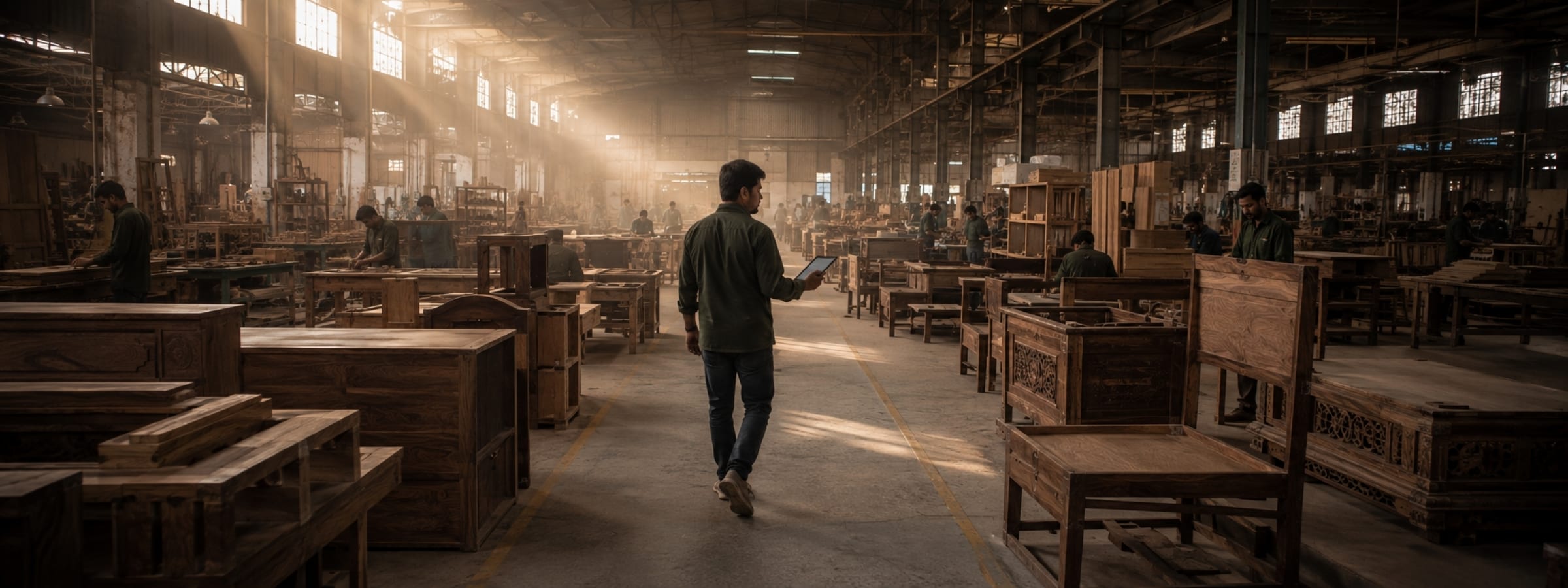
Biosecurity outranks quality here
Every consignment is risk-assessed on arrival; whether it is physically inspected depends on DAFF’s profiling, which weighs tariff classification, country of origin, supplier and the importer’s own compliance history. Furniture triggers that assessment twice over — timber content and timber packaging. Solid timber, bamboo and rattan can all harbour insects and plant disease, and manufactured boards like MDF and plywood are lower risk but still assessed case by case.
Telling every supplier to fumigate everything. Requirements vary by species, construction, manufacturing process and country of origin, and the applicable BICON conditions should be checked first — some treatments are not suitable for painted, varnished or coated timber. Blanket fumigation can damage your finish and still leave you non-compliant on the thing that actually mattered.
Brown marmorated stink bug seasonal measures run 1 September to 30 April and apply to goods manufactured in or shipped from target risk countries — the United States, Canada and almost all of continental Europe, plus Türkiye, Russia and Central Asia. India is on neither the target risk nor the emerging risk list, so Indian-origin furniture does not attract BMSB treatment requirements. Two caveats worth knowing: furniture sits in tariff chapter 94, which is not a target high risk good even from a listed country, so mandatory treatment would not attach to it in any case; and goods shipped from, or unpacked and repacked in, a target risk country can be caught regardless of where they were made. DAFF republishes the country list each August. If a forwarder is quoting you offshore BMSB treatment on a Mundra sailing, ask them to point to the requirement. Vessel routing can still matter, so confirm with your broker.
Timber legality and consumer law
One country, two opposite climates
Perth, Adelaide and inland Australia are dry enough to split Indian hardwood. Brisbane, Sydney and the tropical north are humid enough to mould it. A single national specification produces claims at both ends.
| Destination | What happens to the wood | Typical MC |
|---|---|---|
| Indian workshop, unmanaged | Kiln cycles cut short when orders run late. | 12–16% |
| Perth, Adelaide, inland | Dry, heated or air-conditioned interiors. Wood sheds moisture and shrinks across the grain. | 7–9% |
| Sydney, Melbourne | Temperate and moderate — the most forgiving destinations on this route. | 9–11% |
| Brisbane, tropical north | Humid year-round. Mould and swelling rather than cracking. | 11–13% |
| Our shipping specification | Set to the destination state, not a national average. | 9–11% |
TELL US THE STATE — if your stock goes to Perth we specify drier; if it goes to Cairns we specify wetter and put more weight on desiccant and ventilation at stuffing.
Four failures on the India–Australia route
Someone else's pallets
The factory holds an ISPM 15 certificate; the pallets under your cartons are unmarked scrap from the yard. Nobody checks at origin because nobody is there, and the hold happens 9,000 km later.
Bark, soil and insects
Cheap and trivial to fix at the loading bay. Expensive and slow to fix at Port Botany, where treatment can also mark your finish.
Moisture set to the wrong climate
Stock specified for Sydney sent to Perth splits through summer. Stock specified for Perth sent to Cairns swells and moulds. Both are avoidable by specifying per state.
Volume, not weight
Australian furniture freight is usually charged by volume. Suppliers quote assembled dimensions rather than final packed carton dimensions and gross weights, and your landed cost lands wrong.
India to Australia, and where inspection fits
Typical routing
- Jodhpur / Jaipur cluster to portROAD 1–2 DAYS
- Mundra or Nhava ShevaORIGIN PORT
- Sea transit to east coast~3–5 WEEKS
- Sydney · Melbourne · BrisbaneEAST COAST
- Fremantle · AdelaideWEST & SOUTH
Where we intervene
- Supplier verified before depositPRE-ORDER
- Moisture & build at 80% packedPSI
- ISPM 15 marks photographedLOADING
- Container checked for contaminationLOADING
- Carton dims & gross weights verifiedLOADING
THE POINT — a shorter sailing than Europe or the US, which means less time to fix anything once it leaves. Biosecurity is decided at the loading bay.
Published pricing, paid by you
We take no commission from factories. Prices in USD; AUD invoicing available on request.
Pre-Shipment Inspection
AQL 2.5 sampling to ISO 2859-1, moisture against your destination state, labelling checked, report in 24 hours.
BookProtected Container
Inspection plus loading supervision — ISPM 15 marks photographed, container checked for contamination, carton data verified, seal recorded.
Protect my containerFirst Order Shield
Supplier verification, during-production inspection and pre-shipment inspection — built for a first order in India.
Start protectedFOR AUSTRALIA WE USUALLY RECOMMEND LOADING SUPERVISION — biosecurity outcomes are decided at stuffing, not at inspection.
Australian importers ask
Should I just tell my supplier to fumigate everything?
No — this is the most expensive habit we see. Requirements vary by species, construction, manufacturing process and origin, and the applicable BICON conditions should be checked first. Some treatments are not suitable for painted, varnished or coated timber, so blanket fumigation can damage your finish while still leaving you exposed on the thing that actually mattered, usually the packaging.
Can you verify ISPM 15 compliance at the factory?
Yes, and it is the single highest-value check on this route. We photograph the ISPM 15 stamp on the actual pallets and crates going under your goods, rather than accepting a certificate that may relate to different timber. Unmarked packaging is the commonest cause of a hold, and it costs almost nothing to correct while the container is still open.
Do I need BMSB treatment on Indian-origin furniture?
Generally not. Seasonal brown marmorated stink bug measures run September to April and apply to goods manufactured in or shipped from target risk countries, principally the United States and much of Europe. India is not among them. Vessel routing can still bring measures into play, so confirm with your broker — but you should not be paying for offshore BMSB treatment on a straightforward Mundra sailing without a stated reason.
What moisture content should I specify?
Tell us the destination state and we will set it. As a general specification we recommend 9–11%, but Perth, Adelaide and inland destinations warrant drier stock at 8–10%, while Brisbane and the tropical north sit at the other end and need more attention to desiccant and ventilation than to dryness.
How fast can you get to a factory?
Same day in Jodhpur and Jaipur, 24 hours in Delhi NCR, 48–72 hours in Saharanpur, Moradabad and Kolkata. Bookings confirmed within two hours with a fixed quote. Australian eastern time runs four and a half to five and a half hours ahead of us, so a request sent in your morning is answered the same working day.
Are you connected to any Indian factory or agent?
No. Qualis is buyer-paid and takes zero commission from factories. Supplier shortlisting is a fixed fee paid by you and firewalled from inspection work. An inspector paid by the party being inspected has no reason to fail anything.
Biosecurity is decided by DAFF, not by us
A biosecurity direction is a government decision made on arrival. What we can do is remove the reasons for one before the container leaves India.
What we do
- ✓Photograph the ISPM 15 mark on the actual pallets and dunnage under your goods.
- ✓Check natural fibre and timber for residual damp and pest evidence at the point it is wrapped.
- ✓Verify species and material declarations match what is physically in the carton.
- ✓Inspect packaging for bark, soil, seeds and live pests before loading.
What we don't do
- —Clear your goods through biosecurity, or predict a BICON outcome. Conditions are set case by case by DAFF.
- —Perform or certify offshore treatment. Only a DAFF-approved offshore treatment provider can do that.
- —Issue ISPM 15 marks. Those come from an accredited treatment provider.
- —Give customs or legal advice. We document facts; your broker interprets them.
The pages behind this guide
Everything above is decided in a factory in India, not at the port. These are the services that catch it, the clusters they run in, and the reason we can fail a shipment without losing money by it.
Services, in order of use
- Supplier verificationBEFORE DEPOSIT
- During-production inspectionMID-RUN
- Pre-shipment inspectionPRE-PAYMENT
- Container loading supervisionAT LOADING
Clusters that build Australian orders
- JodhpurHQ · SAME DAY
- JaipurSAME DAY
- KolkataCANE & RATTAN
- All six clustersRISK GUIDE
Before you book
- The Independence CharterCHARTER
- What a report containsUNGATED
- Compliance mapALL MARKETS
RELATED MARKET GUIDES
Your next Australia-bound container
Send the factory, the product mix, the destination state and the loading date. We confirm within two hours with scope and a fixed quote — and we will tell you plainly which biosecurity checks are worth paying for on your particular consignment.