Importing furniture from India to the USA
American interiors are the driest of any market we ship to, and American paperwork is the heaviest. Wood has to leave India at a moisture content most Indian workshops never hit, and every container needs species declarations, formaldehyde certification and — for dressers and upholstery — test reports that trace to the batch actually built.
Based in Jodhpur since 2017 · Paid by buyers, never by factories · Reports in 24 hours
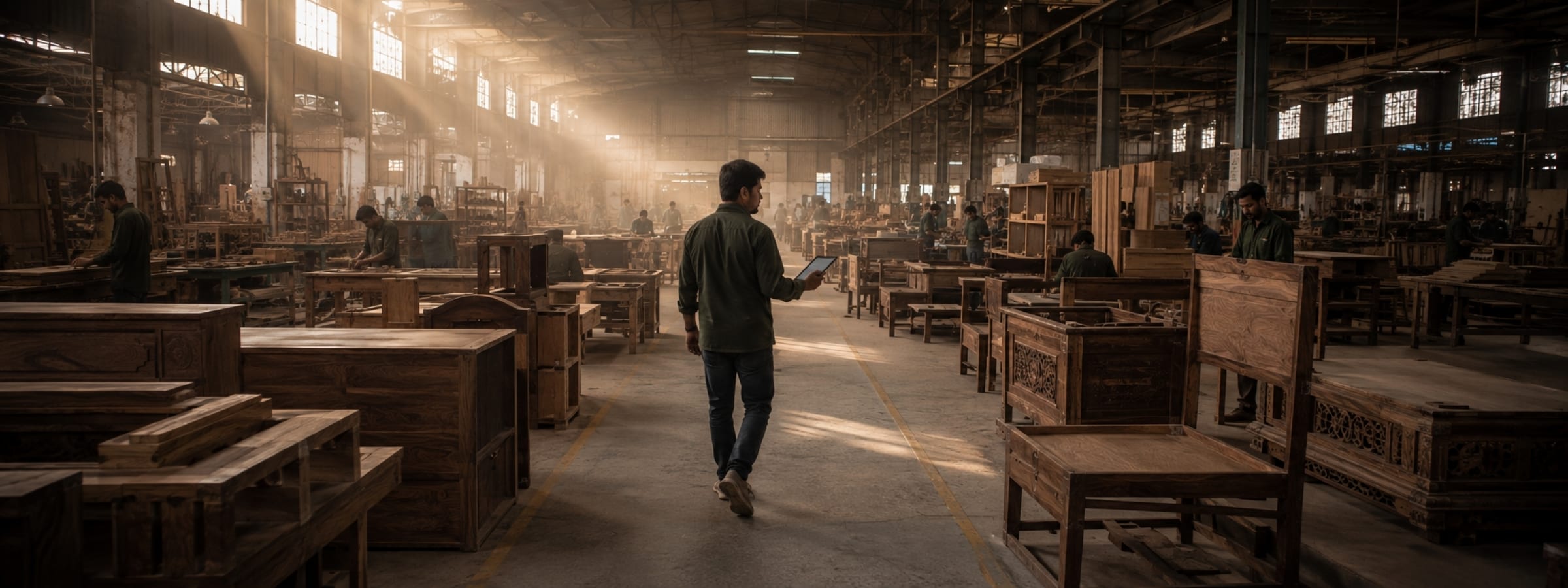
The driest destination we ship to
Forced-air heating through a northern winter takes interiors drier than a British or German home. Furniture built to a Rajasthan workshop's moisture content does not survive its first January in Chicago or Denver.
| Condition | What happens to the wood | Typical MC |
|---|---|---|
| Indian workshop, unmanaged | Kiln cycles cut short when orders run late. Timber equilibrates to warm, humid air. | 12–16% |
| Container, 4–6 weeks at sea | Heat and trapped humidity; finish can bloom, moisture redistributes through the batch. | — |
| Heated US interior, winter | Forced-air heating in the Northeast, Midwest and Mountain states. Wood sheds moisture and shrinks. | 5–8% |
| Humid South & coastal | Florida, Gulf Coast and coastal California run wetter year-round — the opposite problem. | 9–12% |
| Our shipping specification | Tighter than any European market. Narrow the gap at origin or absorb it in returns. | 7–9% |
American consumers return furniture. A cracked tabletop that a European buyer might negotiate over becomes an Amazon or Wayfair return, a one-star review, and in a marketplace model a chargeback against you. The financial consequence of shipping wet wood is larger here than in any other market on our list.
HOW WE CHECK — multiple pin-meter readings per item across tops, panels and rails, recorded individually rather than averaged, photographed with the meter in frame, and failed against the destination specification rather than a generic number.
Five frameworks, and the paperwork now files electronically
The US does not have EUDR, but it has a documentation load that catches importers who assume otherwise. Paper Lacey Act declarations ended on 1 January 2026 — filings now go through CBP's ACE system or the APHIS Lacey Act web service.
Not at the filing. At the source. A Lacey declaration needs a scientific name and a country of harvest, and a Jodhpur factory buying through timber yards frequently cannot produce either with confidence. A TSCA certificate is only as good as the panel actually used in your batch. Both are verifiable on site — and only on site.
Four failures on the India–US route
Wet wood into dry homes
The largest claim category on US-bound orders. Sheesham shipped above 10% shrinks hard in a forced-air heated interior, and the splits surface four to eight weeks after delivery — as returns, not shipping disputes.
Packaging built for a shorter journey
US e-commerce means parcel and LTL handling after a six-week sea leg. Cartons that survive an Indian domestic trip fail six-orientation drop testing, and a high return rate is almost always a packaging problem rather than a product one.
Certified components swapped mid-run
Certified panel or foam runs out, cheaper stock goes in, and the certificate on file no longer describes what is in the container. Only catchable by someone standing in the factory during production.
Species nobody can actually name
A Lacey declaration needs a genus and species and a country of harvest. Timber bought through yards often arrives with a purchase invoice and a common name — which is not the same thing.
If you sell through Amazon, Wayfair, Target or Home Depot
The US is the world's largest furniture importer, and its e-commerce channel generated roughly $72.9 billion in 2025, with Amazon, Home Depot and Walmart leading online. Every one of those channels enforces its own routing guide, and non-compliance is charged back to you.
What we check for marketplace sellers
- ✓ISTA 3A drop testing across six orientations, run on the actual production packaging.
- ✓Carton markings, barcodes and labelling against your routing guide before the container is sealed.
- ✓Carton dimensions and weights verified — dimensional errors drive freight and fulfilment chargebacks.
- ✓Assembly hardware counted and bagged per unit, the single most common one-star review cause.
- ✓Moisture specified to the destination region, not a national average.
- RISK
- 22% transit-damage return rate on flat-pack furniture.
- FINDING
- Drop tests failed 4 of 6 orientations. Packaging respecced with corner blocks and honeycomb board.
- OUTCOME
- Return rate fell to 6% across two shipments.
India to the USA, and where inspection fits
Typical routing
- Jodhpur / Jaipur cluster to portROAD 1–2 DAYS
- Mundra or Nhava ShevaORIGIN PORT
- Suez to East Coast~5–7 WEEKS
- New York / Savannah / HoustonEAST COAST
- Los Angeles / Long BeachWEST COAST
Where we intervene
- Supplier verified before depositPRE-ORDER
- Species & panel certs tracedDUPRO
- Moisture & build at 80% packedPSI
- ISTA 3A drop testingPACKAGING
- Count, markings, seal at stuffingLOADING
THE POINT — a detained container costs demurrage daily while you argue about a species name. Every check above happens while the goods are still the factory's problem.
Published pricing, paid by you
We take no commission from factories. Prices in USD.
Pre-Shipment Inspection
AQL 2.5 sampling to ISO 2859-1, moisture against the US destination spec, labelling and markings checked, report in 24 hours.
BookProtected Container
Inspection plus loading supervision — count against your invoice, carton markings, condition, seal photographed, 12-hour reporting.
Protect my containerFirst Order Shield
Supplier verification, during-production inspection and pre-shipment inspection — built for importers placing a first order in India.
Start protectedUS importers ask
What moisture content should I specify for the US market?
7–9% for solid hardwood, verified with multiple readings per item rather than a batch average. That is tighter than we recommend for the UK or Germany, because forced-air heating in the northern US takes interiors drier than European homes. If your volume goes primarily to Florida or the Gulf Coast the risk inverts and we would specify differently — tell us the destination region, not just the country.
Can you verify Lacey Act species information at the factory?
We can verify what is verifiable and tell you plainly what is not. We check the species declared against what is physically in the batch, trace the timber back through yards and traders as far as the chain genuinely goes, and photograph the purchase and transit documents. What we cannot do is invent a country of harvest that the supply chain never recorded — and knowing that before you file is the point.
Do you check TSCA Title VI compliance?
We trace the certification to the actual panel in production, which is where it usually breaks. Certified stock runs out mid-run, cheaper board goes in, and the certificate on file no longer describes the container. We are not a testing laboratory — emissions testing is done by an EPA-recognised third-party certifier — but we can confirm whether the certificates are current, genuine and matched to your goods.
We sell on Amazon and Wayfair. What should we prioritise?
Packaging and carton data before anything else. Most marketplace losses on Indian furniture are transit damage and routing-guide chargebacks rather than product defects. ISTA 3A drop testing on the real production packaging, plus verified carton dimensions, weights and markings, will move your return rate more than any additional quality check.
How quickly can you get to a factory?
Same day in Jodhpur and Jaipur, 24 hours in Delhi NCR, 48–72 hours in Saharanpur, Moradabad and Kolkata. Bookings confirmed within two hours with a fixed quote. India is 9.5 to 12.5 hours ahead of US time zones, so a request sent at the end of your working day is usually answered before you start the next one.
Are you connected to any Indian factory or agent?
No. Qualis is buyer-paid and takes zero commission from factories. Supplier shortlisting is a fixed fee paid by you and firewalled from inspection work. An inspector paid by the party being inspected has no reason to fail anything.
We verify the paperwork against the goods. We do not produce the paperwork.
The US load is documentary, and almost every failure is a mismatch between a genuine document and the container it is supposed to describe. That mismatch is findable in a factory. The documents themselves are not ours to issue.
What we do
- ✓Trace TSCA Title VI certification to the actual panel in production, which is where it usually breaks.
- ✓Record species, and the country-of-harvest evidence the supply chain can actually support, for your Lacey declaration.
- ✓Verify tip-over test reports exist for clothing storage units and match the unit as built.
- ✓Check labelling, markings and carton data before the container is sealed.
- ✓Catch component substitution after your sample was approved.
What we don't do
- —Perform emissions testing. That is done by an EPA-recognised third-party certifier.
- —Perform or certify ASTM F2057 tip-over testing. That is an accredited laboratory's work.
- —File your Lacey Act declaration, or invent a country of harvest the chain never recorded.
- —Issue any certificate of compliance, or give customs or legal advice.
The pages behind this guide
Everything above is decided in a factory in India, not at the port. These are the services that catch it, the clusters they run in, and the reason we can fail a shipment without losing money by it.
Services, in order of use
- Supplier verificationBEFORE DEPOSIT
- During-production inspectionMID-RUN
- Pre-shipment inspectionPRE-PAYMENT
- Container loading supervisionAT LOADING
Clusters that build US orders
- JodhpurHQ · SAME DAY
- JaipurSAME DAY
- Delhi NCRUPHOLSTERY
- All six clustersRISK GUIDE
Before you book
- The Independence CharterCHARTER
- What a report containsUNGATED
- Compliance mapALL MARKETS
RELATED MARKET GUIDES
Your next US-bound container
Send the factory, the product mix, the destination region and the target ship date. We confirm within two hours with scope and a fixed quote — including the moisture specification for where the furniture will actually live.