Chests of drawers: quality issues and what to check before you order and before packing
A chest of drawers is the piece most likely to tip: with drawers open and loaded, it can fall on a child. For the US it usually falls under the tip-over rule. After that come drawers that stick or pull out, carcasses out of square and cracking. Specify runners, stops and the tip-over kit in the order, and check stability with drawers open before shipment.
How it is usually made: A carcass with stacked drawers on wooden or metal runners, a back that is often plywood or MDF, and drawer bottoms often plywood.
Put these in the purchase order
An inspector can only hold the factory to what is written down. Add your AQL, moisture limit and golden sample to every order as well.
| Specify | Why it matters |
|---|---|
| US tip-over compliance | If sold in the US and within the size thresholds: test report, tip-over restraint and warning label. |
| Runner type and drawer stops | Runner type and supplier, and stops so drawers cannot be pulled out. |
| Drawer construction | Joinery of drawer boxes and drawer bottom material. |
| Back and drawer bottom material | Plywood or MDF brings formaldehyde rules into scope. |
| Moisture limit and golden sample | For carcass, top and drawer fronts. |
Defects to look for on a solid wood chest of drawers
Usual class by our default definitions: critical is unsafe or unshippable, major affects function, saleability or durability, minor is cosmetic. Your own defect list always overrides it.
| Defect | Usual class | Usual cause | How it is checked |
|---|---|---|---|
| Unit tips with drawers open | Critical | Heavy drawers, shallow carcass, no restraint supplied. | Open all drawers on a flat floor; check the restraint and label are in the kit. |
| Drawers pull out and drop | Major | No stops fitted. | Pull every drawer fully open. |
| Drawers sticking or racking | Major | Carcass out of square, runners out of line. | Cycle every drawer; check carcass diagonals. |
| Missing tip-over restraint or warning label | Major | Left out of the kit. | Count the kit; check the label against your label list. |
| Cracked top or drawer fronts | Major | Above the moisture limit. | Pin-meter readings; inspect top and fronts. |
| Uneven gaps around drawer fronts | Minor | Fronts fitted by eye. | Check gaps against the tolerance. |
Chests of drawers we have inspected
Photos from our inspections and our anonymised sample inspection reports. Brand names, item numbers, labels and people are blurred.
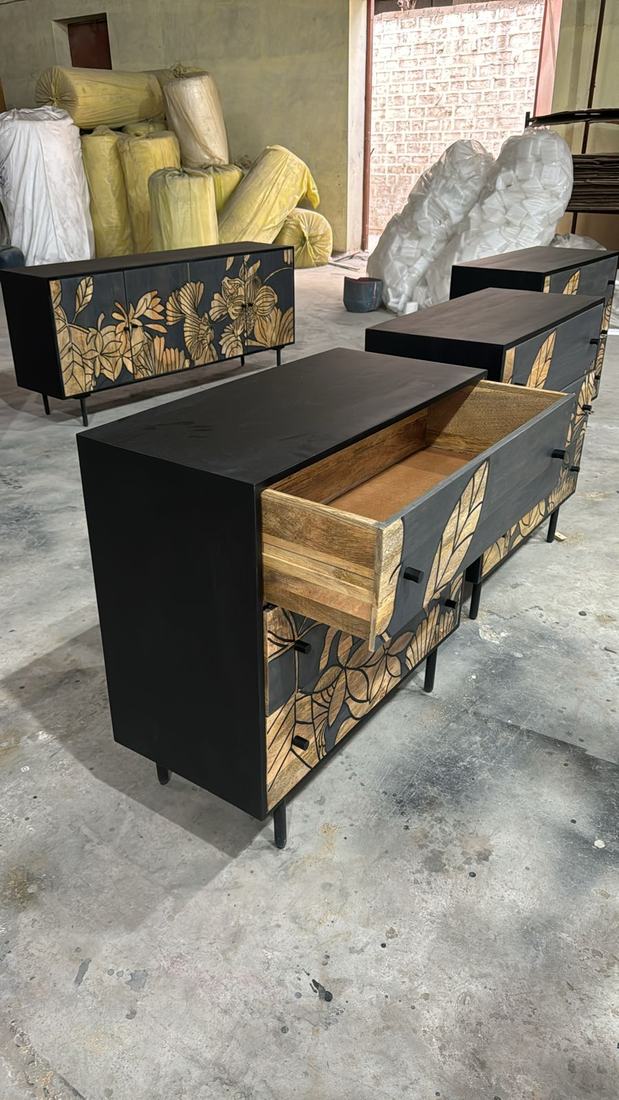
What to check during production, at inspection and before packing
During production
- Carcass square on first units, checked by diagonals.
- Runner fitting and stops on first drawer boxes.
- Moisture of top and front stock.
At pre-shipment inspection
- Open all drawers on a flat floor and check stability; for US orders confirm the restraint and warning label.
- Cycle every drawer and pull each fully open to test the stop.
- Check drawer-front gaps and carcass square.
- Verify the tip-over test report matches the unit as built.
Before packing
- Drawers secured shut so they cannot slide out in transit.
- Tip-over restraint, instructions and hardware sealed together.
- Top and corners protected.
Moisture, finish and sampling
- Moisture: put a limit for your destination in the PO and have it read with a pin meter on sampled pieces. Wood shipped wet cracks after delivery. Targets by market are in the wood guide.
- Finish: approve a golden sample and hold every batch to it; finishes cured in humid weather can bloom in transit.
- Sampling: AQL 2.5 for major and 4.0 for minor defects at General Level II by default. The AQL calculator gives the sample size for your order.
- Hardware: count kits against the bill of materials; wrong or missing hardware turns a sound product into a return.
Rules that may apply to a chest of drawers
| Rule | When it applies |
|---|---|
| US tip-over rule (STURDY Act, ASTM F2057-23) | If at least 27 in tall, 30 lb and 3.2 ft³ of enclosed storage. |
| Formaldehyde (TSCA Title VI, REACH) | If the back or drawer bottoms are plywood or MDF. |
Chests of drawers: questions
Does a chest of drawers need tip-over testing for the US?
Yes, if it is a free-standing clothing storage unit at least 27 inches tall, 30 lb and 3.2 cubic feet of enclosed storage: test report, tip-over restraint and warning label.
What do inspectors check on drawers?
That every drawer runs smoothly, stops before it can be pulled out, and sits with even gaps; and that the chest stays stable with all drawers open.
Related guides
- Wardrobes: Tip-over safety, large-door warp and hinge sag, hanging rail, knock-down fittings.
- Bedside tables: Drawer runners and stops, matching pairs, top cracking, wobble.
- Wooden beds: Rail-to-post fit, slat and centre-rail support, mattress fit, multi-carton completeness.
- Dressing tables: Mirror fixing, drawers and stops, stability with a tall mirror, stool match.
- All furniture inspection guides
- Free furniture inspection checklist (PDF)
Have your chest of drawers order checked before you pay
Tell us the factory, the product and the date. We reply with scope and a fixed quote within 24 hours. A pre-shipment inspection starts at $249.
Talk to an inspector Pre-shipment inspection