Marble and stone-top tables: quality issues and what to check before you order and before packing
A marble or stone-top table fails where stone meets wood: cracks along natural veins, tops that break in transit, bases that cannot carry the weight, and tops that slide because nothing holds them. Stone also varies piece to piece. Specify the stone, thickness, finish, sealing and how the top is located on the base, then inspect every sampled top before it is crated.
How it is usually made: A marble or other natural-stone top resting on, or fixed to, a solid wood or wood-and-iron base, usually with locating blocks, pins or adhesive pads; the top is normally shipped separately from the base.
Put these in the purchase order
An inspector can only hold the factory to what is written down. Add your AQL, moisture limit and golden sample to every order as well.
| Specify | Why it matters |
|---|---|
| Stone name, thickness and finish | Name the stone, the thickness and polished or honed finish, with photos of the acceptable range of colour and veining. |
| Filled fissures and repairs | Say whether resin-filled fissures are acceptable and how visible they may be. Many natural stones have them. |
| Sealing | Marble is porous and stains. State whether the top is sealed and with what. |
| Top-to-base fixing | Locating blocks, pins or pads so the top cannot slide, and the base specified for the weight of the stone. |
| Crating specification | Stone is heavy and breaks on edges and corners. Agree crate construction and orientation. |
Defects to look for on a marble-top table
Usual class by our default definitions: critical is unsafe or unshippable, major affects function, saleability or durability, minor is cosmetic. Your own defect list always overrides it.
| Defect | Usual class | Usual cause | How it is checked |
|---|---|---|---|
| Top can slide or lift off the base | Critical | No locating blocks or pins; pads missing. | Place the top on the assembled base and push it sideways. |
| Base fails or racks under the stone | Critical | Base designed for a wooden top; joints too small for the weight. | Assemble with the stone on; rack and rock-test. |
| Crack through the top | Critical | Fault along a vein, impact, or a top crated flat without support. | Inspect both faces and edges of each sampled top under raking light. |
| Chipped edges or corners | Major | Handling and poor edge protection. | Run a hand and eye along every edge and corner. |
| Unacceptable filled fissures or colour outside the agreed range | Major | Slabs not selected against the approved range. | Compare each top with the approved photos or sample. |
| Unsealed or stained top | Major | Sealing skipped; tops marked in the workshop. | Water drop test on an inconspicuous area if sealing is specified; inspect for marks. |
| Polish uneven or dull patches | Minor | Uneven polishing. | Raking light across the top. |
Marble and stone-top tables we have inspected
Photos from our inspections and our anonymised sample inspection reports. Brand names, item numbers, labels and people are blurred.
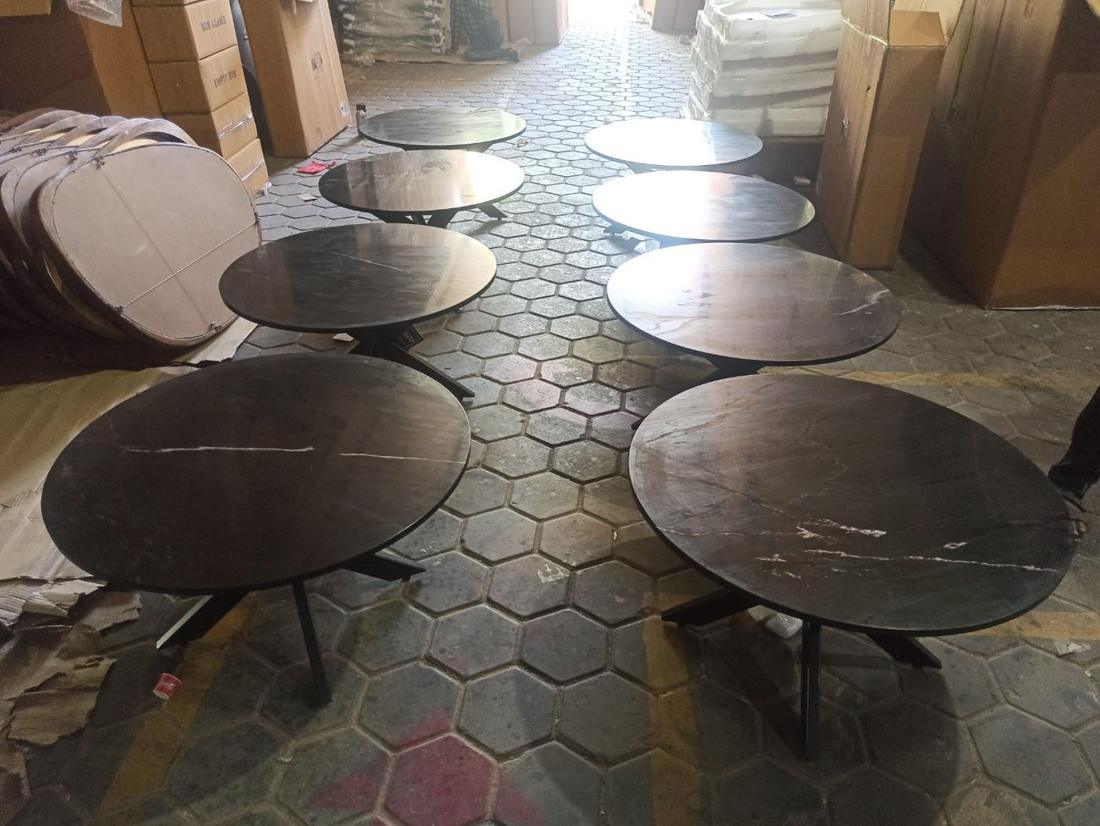
What to check during production, at inspection and before packing
During production
- Stone slabs or cut tops against the approved colour and veining range before finishing.
- Base joints and fixings checked on the first units for the stone weight.
- Sealing done and cured before tops are crated.
At pre-shipment inspection
- Inspect both faces and every edge of sampled tops under raking light.
- Compare colour, veining and filled fissures against the approved range.
- Assemble sampled bases, place the stone and check fixing, rocking and racking.
- Check sealing if specified.
- Check the wooden base finish against its golden sample.
Before packing
- Each top in its own crate, supported along its length, usually on edge, with corners protected.
- Base packed separately; locating blocks, pins and pads sealed in a labelled bag.
- Crate marked as fragile and heavy, with the orientation and weight.
- Crates and pallets meet ISPM 15 where they are solid wood.
Moisture, finish and sampling
- Moisture: put a limit for your destination in the PO and have it read with a pin meter on sampled pieces. Wood shipped wet cracks after delivery. Targets by market are in the wood guide.
- Finish: approve a golden sample and hold every batch to it; finishes cured in humid weather can bloom in transit.
- Sampling: AQL 2.5 for major and 4.0 for minor defects at General Level II by default. The AQL calculator gives the sample size for your order.
- Hardware: count kits against the bill of materials; wrong or missing hardware turns a sound product into a return.
Rules that may apply to a marble-top table
| Rule | When it applies |
|---|---|
| ISPM 15 | If the stone ships in solid wood crates or on wooden pallets. |
| EN 12521 (domestic tables) | Often referenced by EU buyers for strength and stability. |
| Lacey Act | For the wooden base on US orders. |
Marble and stone-top tables: questions
Are filled fissures in a marble top a defect?
Only if the order says so. Many natural stones have resin-filled fissures. Agree what is acceptable, with photos, in the PO, and the inspector checks each top against it.
Why do marble table tops break in transit?
Usually poor crating: a heavy slab packed flat without support or with unprotected corners. Crate each top separately, supported along its length.
What should be checked on the base of a marble table?
That it carries the stone without racking or rocking, and that blocks, pins or pads stop the top sliding off.
Related guides
- Dining tables: Top cracking and cupping, top fixings that allow movement, leg fixing, wobble.
- Coffee tables: Top cracking and cupping, lift-top and drawer mechanisms, glass, edges, wobble.
- Iron and wood furniture: Welds, sharp edges, powder coating and rust, metal-to-wood fixings, stability.
- All furniture inspection guides
- Free furniture inspection checklist (PDF)
Have your marble-top table order checked before you pay
Tell us the factory, the product and the date. We reply with scope and a fixed quote within 24 hours. A pre-shipment inspection starts at $249.
Talk to an inspector Pre-shipment inspection