Sideboards: quality issues and what to check before you order and before packing
A solid wood sideboard fails at its moving parts and panels: doors that do not line up or sag on their hinges, drawers that stick, shelves that bow, and a top or panels that crack.
Specify hinges, runners and panel materials in the order, then open and close every door and drawer on sampled units before shipment.
How it is usually made: A carcass of solid wood frames and panels with doors on hinges, drawers on runners, shelves on pins or fixed, and a back that is often plywood or MDF.
Put these in the purchase order
An inspector can only hold the factory to what is written down. Add your AQL, moisture limit and golden sample to every order as well.
01Hinge and runner specificationType and make of hinges and runners; cheap runners are the first thing to fail in use.02Door and drawer gapsThe even gap you expect around doors and drawer fronts, with a tolerance.03Back and shelf materialsSolid, plywood or MDF. Composite panels bring formaldehyde rules into scope.04Handles, locks and keysHandle model, fixing and any locks, with keys counted per unit.05Moisture limit and golden sampleWide panels and the top move with moisture; agree the finish against a sample.Defects to look for on a solid wood sideboard
Usual class by our default definitions: critical is unsafe or unshippable, major affects function, saleability or durability, minor is cosmetic. Your own defect list always overrides it.
| Defect | Usual class | Usual cause | How it is checked |
|---|---|---|---|
| Unit tips with doors or drawers openDefect library: Tips over with drawers open | Critical | Heavy drawers on a shallow carcass, feet set back. | Open all drawers and doors on a flat floor and watch the unit. |
| Doors misaligned or sagging | Major | Hinges set out of line, carcass out of square, door warped. | Check door gaps and that doors close flush. |
| Drawers sticking or falling out | Major | Runners fitted out of line; no stop fitted. | Open and close every drawer on sampled units. |
| Cracked top or panelsDefect library: Unseasoned timber cracking | Major | Above the moisture limit; panels glued in so they cannot move. | Moisture-meter readings; inspect panels and the top. |
| Shelves bowing or pins missing | Major | Thin shelves over a long span; shelf pins not packed. | Load shelves by hand; count pins. |
| Rough or unfinished interior | Minor | Interior finishing skipped to save time. | Open the unit and inspect inside surfaces. |
Sideboards we have inspected
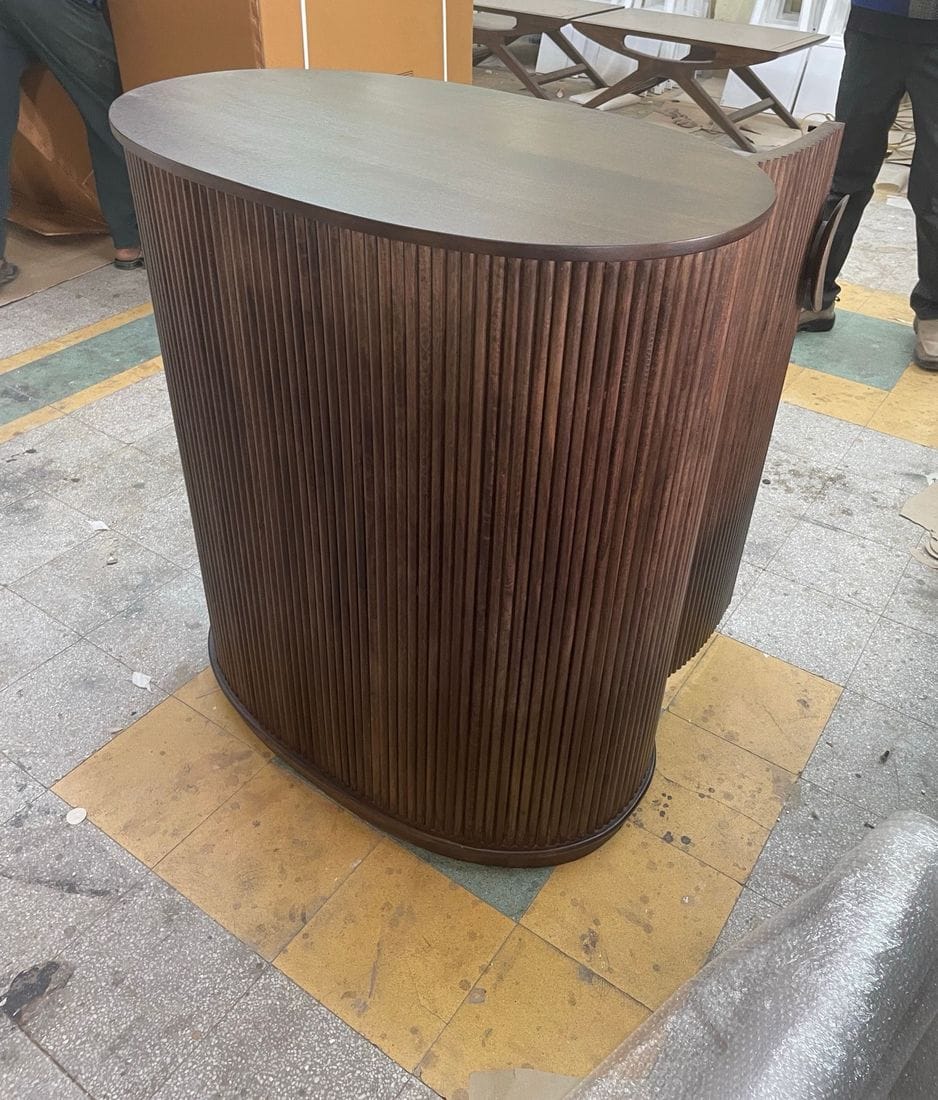
Photos from our inspections and our anonymised sample inspection reports. Brand names, item numbers and labels are blurred.
What to check during production, at inspection and before packing
During production
- Carcass assembled square on first units, checked by diagonals.
- Hinges and runners from the specified supplier.
- Moisture of panel and top stock.
At pre-shipment inspection
- Open and close every door and drawer on sampled units; check stops.
- Measure door and drawer gaps against the tolerance.
- Open everything at once on a flat floor and check the unit stays stable.
- Count handles, shelf pins and keys against the BOM.
- Check the back panel is fixed and the interior finished.
Before packing
- Doors and drawers held shut with blocks or tape that leaves no mark.
- Glass shelves or doors packed separately with their own protection.
- Feet and top corners protected; unit packed upright if specified.
- Keys and spare parts taped inside in a labelled bag.
Moisture, finish and sampling
Moisture: put a limit for your destination in the PO and have it read with a moisture meter on sampled pieces. Wood shipped wet cracks after delivery. Targets by market are in the wood guide.
Finish: approve a golden sample and hold every batch to it; finishes cured in humid weather can bloom in transit.
Sampling: AQL 2.5 for major and 4.0 for minor defects at General Level II by default. The AQL calculator gives the sample size for your order.
Hardware: count kits against the bill of materials; wrong or missing hardware turns a sound product into a return.
Sideboards: questions
More answers in the furniture inspection FAQ.
What fails first on a solid wood sideboard?
Does the US tip-over rule apply to sideboards?
Should the back panel be solid wood?
Related guides
TV units
Top load and sag, cable openings, flap and drawer function, stability, back panels.
Console tables
Stability on a narrow base, wall fixing, wobble, drawers, top cracking.
Dining tables
Top cracking and cupping, top fixings that allow movement, leg fixing, wobble.
Cabinets and cupboards
Display, bar and storage cupboards: glass doors, lighting, flaps, locks, tipping.
Bone inlay furniture
Inlay lifting and cracking, resin gaps, pattern match, substrate and moisture.
Have your sideboard order checked before you pay
Tell us the factory, the product and the date. We reply with scope and a fixed quote within 24 hours. A pre-shipment inspection starts at $249.
Book a pre-shipment inspection Talk to an inspector