Mirrors and mirror frames: quality issues and what to check before you order and before packing
A wooden-framed mirror fails at its hanging fixings, its glass and its frame: hangers that pull out of the wood, mirror glass that distorts or loses its silvering at the edges, chipped corners, and mitre joints that open as the frame dries. Specify the glass, backing and hanging system in the order, then inspect every mirror face and fixing before it is crated.
How it is usually made: A solid wood frame, often carved or with mitred corners, holding mirror glass on a backing board; hung from D-rings, a cleat or a wire, or standing on a base for floor mirrors.
Put these in the purchase order
An inspector can only hold the factory to what is written down. Add your AQL, moisture limit and golden sample to every order as well.
| Specify | Why it matters |
|---|---|
| Mirror glass and thickness | Glass type, thickness and edge finish (bevelled or plain). Thin or poor glass shows distortion. |
| Safety backing | Whether a safety film is required on the back so the glass holds together if broken. |
| Hanging system | D-rings, a cleat or a wire, how they are fixed into the frame, and whether wall fixings are supplied. |
| Backing board and fixing | Backing material and how the glass is held; plywood or MDF backing brings formaldehyde rules into scope. |
| Frame joinery and moisture | Mitre or joint type and a moisture limit, because mitres open when a frame dries. |
Defects to look for on a solid wood mirror frame
Usual class by our default definitions: critical is unsafe or unshippable, major affects function, saleability or durability, minor is cosmetic. Your own defect list always overrides it.
| Defect | Usual class | Usual cause | How it is checked |
|---|---|---|---|
| Hanging fixing pulls out or is fixed into thin backing | Critical | Screws into end grain or into the backing board instead of the frame. | Load each hanger by hand on sampled mirrors; check where it is screwed. |
| Cracked or chipped mirror glass | Critical | Glass forced into the frame, edges unfinished, poor packing. | Inspect the face and all four edges of every sampled mirror. |
| Desilvering or black edges | Major | Moisture or cleaning chemicals reaching the silver at the edges or back. | Inspect edges and corners from the front under good light. |
| Distorted reflection | Major | Low-grade glass, or glass bent by an uneven backing or tight frame. | Look at a straight line in the mirror from several angles. |
| Mitre joints opening, cracked carving | Major | Frame above the moisture limit; joints relying on glue alone. | Pin-meter readings; inspect corners and carved edges. |
| Glass loose in the frame | Major | Too few retaining points. | Press the glass at its edges and listen for rattle. |
| Finish or colour off the sample | Minor | Frames finished in different batches. | Compare against the golden sample. |
Mirrors and mirror frames we have inspected
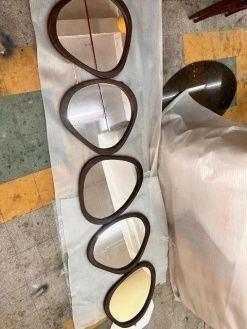
Photos from our inspections and our anonymised sample inspection reports. Brand names, item numbers, labels and people are blurred.
What to check during production, at inspection and before packing
During production
- Moisture of frame stock and mitre fit on the first frames.
- Glass type and edge finish against the specification.
- Hanger positions and fixing on first units.
At pre-shipment inspection
- Inspect the face, edges and corners of every sampled mirror under good light.
- Check reflection for distortion against a straight line.
- Load hangers by hand and check they are screwed into the solid frame.
- Check the backing, retaining points and any safety film.
- Compare frame finish against the golden sample.
Before packing
- Mirror face fully protected; corners in hard protectors.
- Large mirrors in a crate or framed carton, packed upright, marked as glass and "this way up".
- Hanging hardware fixed or sealed in a bag taped to the back.
- Moisture barrier so humidity in transit cannot reach the silvering.
Moisture, finish and sampling
- Moisture: put a limit for your destination in the PO and have it read with a pin meter on sampled pieces. Wood shipped wet cracks after delivery. Targets by market are in the wood guide.
- Finish: approve a golden sample and hold every batch to it; finishes cured in humid weather can bloom in transit.
- Sampling: AQL 2.5 for major and 4.0 for minor defects at General Level II by default. The AQL calculator gives the sample size for your order.
- Hardware: count kits against the bill of materials; wrong or missing hardware turns a sound product into a return.
Rules that may apply to a mirror frame
| Rule | When it applies |
|---|---|
| ISPM 15 | If mirrors ship in solid wood crates or on wooden pallets. |
| Formaldehyde (TSCA Title VI, REACH) | If the backing board is plywood, MDF or hardboard. |
| EN 14072 (glass in furniture) | Often referenced by EU buyers for mirrors fitted in furniture. |
Mirrors and mirror frames: questions
Why do mirror edges turn black?
Moisture or cleaning chemicals reach the silver layer at the edges and corrode it. Inspect edges at pre-shipment and pack mirrors with a moisture barrier.
What is the biggest risk on a wall mirror?
A hanger that pulls out. Check that hangers are screwed into the solid frame, not the backing, and load them by hand.
How should large mirrors be packed?
Upright in a crate or framed carton with full face and corner protection. A wooden crate must meet ISPM 15.
Related guides
- Console tables: Stability on a narrow base, wall fixing, wobble, drawers, top cracking.
- Cabinets and cupboards: Display, bar and storage cupboards: glass doors, lighting, flaps, locks, tipping.
- Bedside tables: Drawer runners and stops, matching pairs, top cracking, wobble.
- Dressing tables: Mirror fixing, drawers and stops, stability with a tall mirror, stool match.
- All furniture inspection guides
- Free furniture inspection checklist (PDF)
Have your mirror frame order checked before you pay
Tell us the factory, the product and the date. We reply with scope and a fixed quote within 24 hours. A pre-shipment inspection starts at $249.
Talk to an inspector Pre-shipment inspection