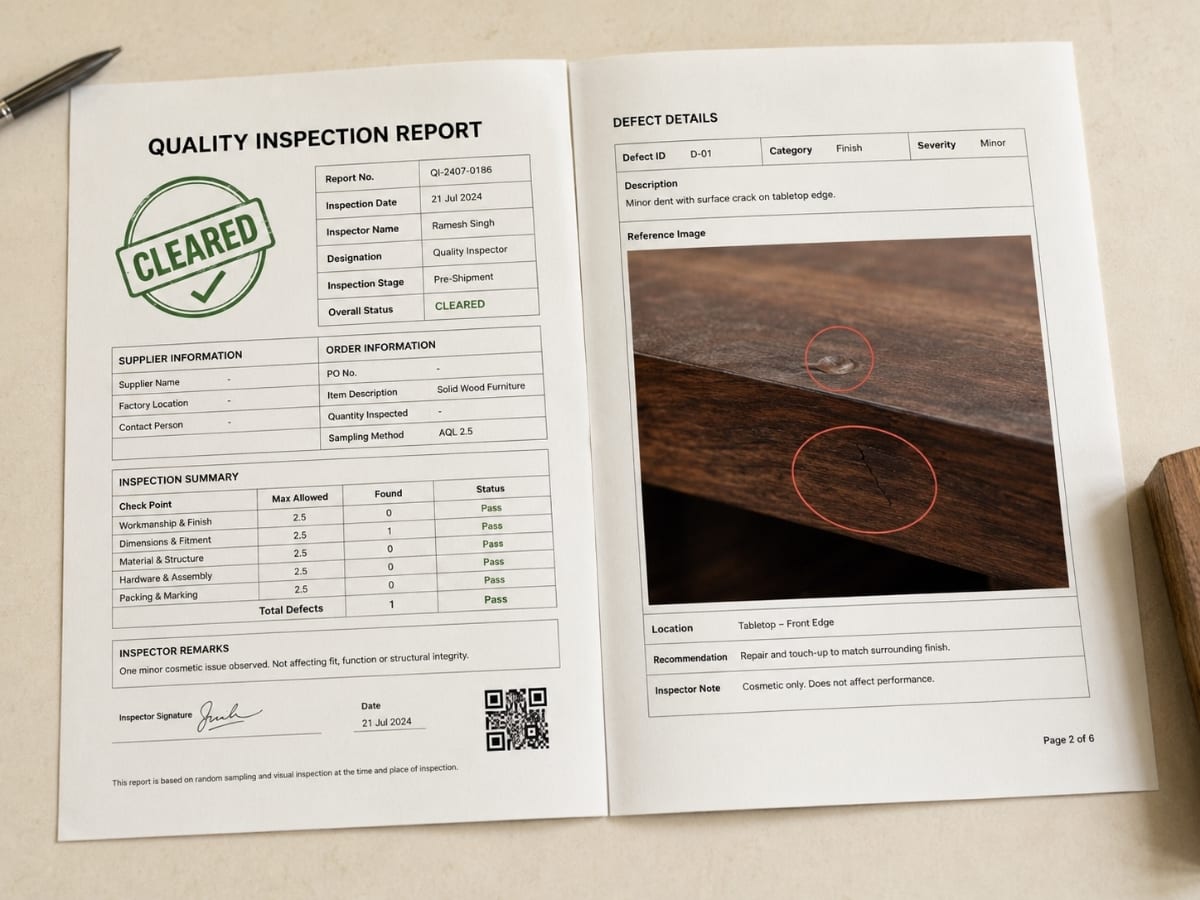
Near the top of every inspection report is a line that decides whether your container ships: something like General Level II · AQL 2.5 / 4.0 · Sample 125 · Accept 7 / Reject 8. Most importers skim it. It is the most consequential line in the document, because it is the rule the inspector applied before writing PASS or FAIL.
What AQL is — and what it is not
AQL stands for Acceptance Quality Limit. It comes from ISO 2859-1 (its American twin is ANSI/ASQ Z1.4), and it is a statistical sampling scheme: a way of deciding whether to accept a whole lot after looking at only part of it.
The common misreading is that AQL 2.5 means “2.5% of my goods will be defective”. It does not. AQL is the defect rate at which a lot will usually still be accepted — the quality level treated as tolerable over a long run of lots. It is a threshold for the sampling plan, not a prediction about your specific container.
The second misreading is more expensive: AQL is a lot-level judgement. A PASS does not mean zero defects. It means the number of defects found in the sample fell at or below the accept number.
The three inputs
1. Lot size
How many finished units are presented for inspection. Not the PO quantity — the quantity actually finished, packed and available on the day. If only 60% of the order is ready, the honest options are to inspect the smaller lot or to reschedule. Inspecting 600 pieces and reporting on 1,000 is how disputes start.
2. Inspection level
General Level II is the default and covers the overwhelming majority of furniture orders. Level I uses smaller samples — cheaper, less confidence. Level III uses larger ones. The Special levels (S-1 to S-4) exist for checks that are slow or destructive: you would use one for a test that requires dismantling a unit, not for a general visual inspection.
3. The AQL numbers themselves
Furniture is usually inspected against two figures, one per defect class — commonly 2.5 for majors and 4.0 for minors. Tighter numbers mean a smaller tolerance for defects, not a bigger sample.
Reading the accept/reject line
Lot size and inspection level together give a code letter, which gives a sample size. Sample size and AQL together give the accept and reject numbers. Four rows importers meet most often, at normal severity, single sampling, General Level II:
| Lot size | Sample | AQL 2.5 (Ac/Re) | AQL 4.0 (Ac/Re) |
|---|---|---|---|
| 281 – 500 | 50 | 3 / 4 | 5 / 6 |
| 501 – 1,200 | 80 | 5 / 6 | 7 / 8 |
| 1,201 – 3,200 | 125 | 7 / 8 | 10 / 11 |
| 3,201 – 10,000 | 200 | 10 / 11 | 14 / 15 |
Read the 1,201–3,200 row: 125 units are pulled at random, and seven major defects is a pass while eight is a fail. That single unit of difference is why defect classification matters as much as the count.
Critical, major, minor
- Critical — unsafe or unlawful. A protruding fastener at a child’s height, a stability failure, a missing regulatory mark. The normal tolerance is zero.
- Major — likely to cause a return, a complaint or a markdown. A wobbling table, a split panel, a drawer that fouls, a finish that differs visibly from the approved sample.
- Minor — a departure from spec that a customer would probably accept. A slight sheen variation on an unseen surface, a small tool mark under a seat rail.
Two inspectors can count the same twelve faults and reach opposite verdicts purely by classifying them differently. That is why classification belongs in your written spec — agreed before production, not argued after loading. It is also why an inspector paid by the factory is a structural problem rather than a personal one: every borderline call has a direction it can quietly drift.
What AQL cannot do
A sampling plan governs how many units to open and how to score them. It says nothing about whether the right things were checked. Moisture content, joint construction, hardware specification, carton drop resistance, packing method and load plan all sit outside the AQL calculation and have to be specified separately.
A report that says only “AQL 2.5, passed” is close to worthless. A useful one records what was measured, against what reference, with photographs.
Choosing your levels
For most furniture programmes, General Level II with 2.5 for majors and 4.0 for minors is a sensible default. Tighten majors to 1.5 on a first order from a new supplier, on high-value pieces, or where the product reaches the customer unboxed. Loosen only where you can genuinely absorb the returns.
Whatever you choose, put it in the PO and in the inspection booking. An AQL agreed at the factory gate on the morning of inspection is not an agreement.
See how a Qualis Assurance pre-shipment inspection is run, or look at a sample report to see these numbers in place.

1 September 2026
Inspection & Standards
Pre-shipment inspection or container loading supervision? What each one actually catches
They happen days apart and sound interchangeable. They protect against completely different failures — and one cannot substitute for the other.
Read →
20 September 2026
Sourcing in India
The Complete Guide to Importing Furniture from India
India offers world-class hardwood furniture at hard-to-match prices — and import risks that stay invisible until the container arrives. This complete…
Read →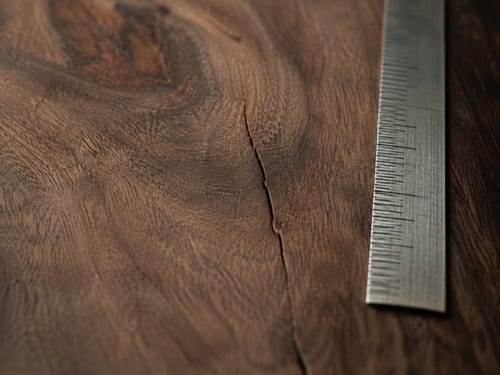
1 September 2026
Materials & Defects
Why Solid Wood Dining Table Tops Crack and Joints Open (And How to Prevent It Before Shipment)
Cracks and opening joints in solid wood dining tables almost always trace back to one cause: wood that shipped too wet. Here's why it happens, and…
Read →Related on this site
The services and references behind this note.
Clusters
Defects it catches
Also useful
Your next India order. Protected.
Confirmed within 2 hours. Report within 24 hours of inspection. Paid by buyers only — never by factories.
Book an inspection