
These two services are booked days apart, often at the same factory, and importers routinely treat them as alternatives. They are not. They answer different questions, and a shipment can pass one while failing badly on the other.
The short version
| Pre-shipment inspection | Container loading supervision | |
|---|---|---|
| Question | Are the goods right? | Did the right goods get on the boat, undamaged? |
| Timing | When production is essentially complete and packed | On the day the container is stuffed |
| Method | Random sample opened and scored against a sampling plan | Full count at the door, plus how it is packed and loaded |
| Typical catch | Finish, construction, dimensions, hardware, function | Wrong quantities, substituted cartons, poor stowage, wet or damaged container |
What pre-shipment inspection is for
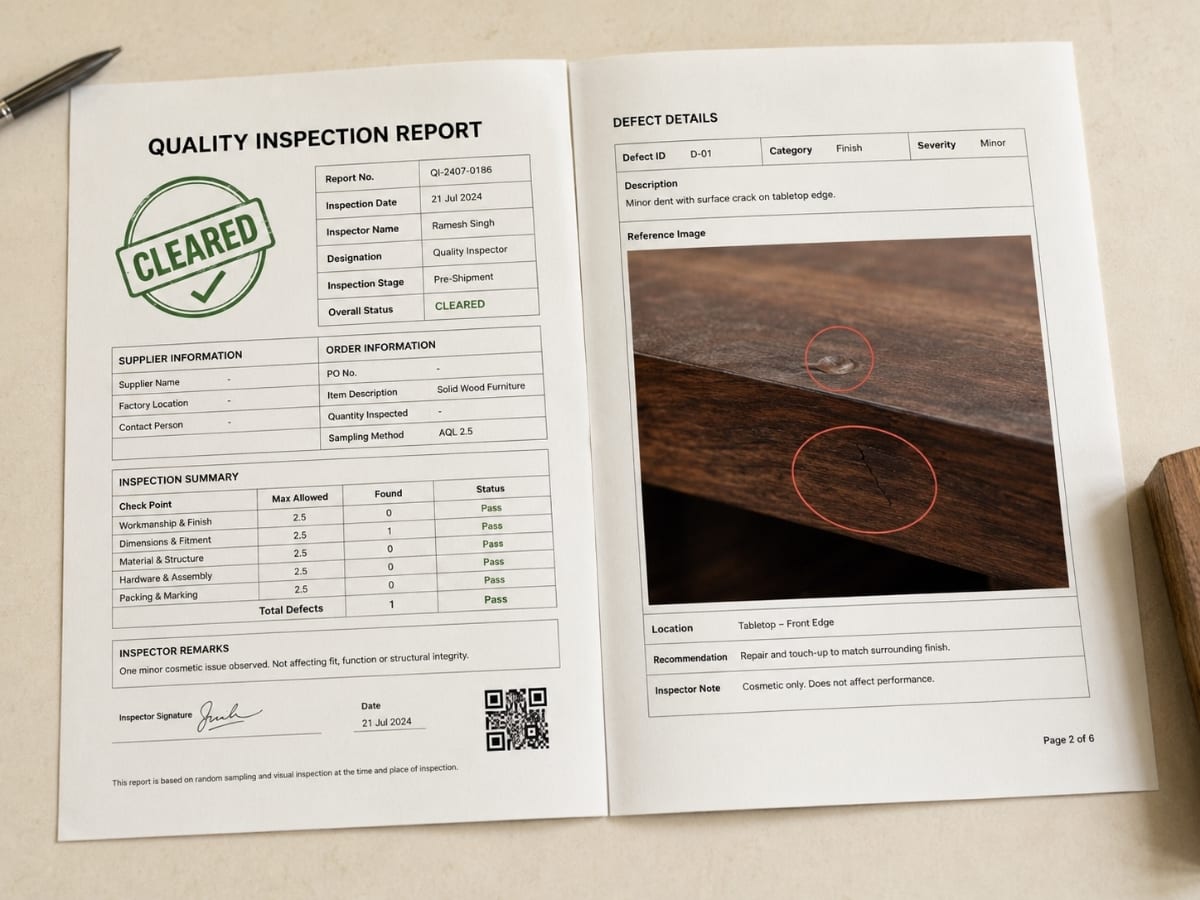
A PSI is a judgement about product quality. Units are drawn at random from the finished, packed lot, opened, and scored against an agreed sampling plan. Defects are counted and classified, dimensions and hardware are checked against the spec, and the result is a pass or fail on the lot.
The critical scheduling detail: a PSI is only meaningful when production is genuinely finished — the usual convention is at least 80% packed. Inspect too early and you are sampling a partial lot, and the units finished after you left are the ones nobody looked at.
What a PSI cannot tell you is what happens next. Inspection typically finishes days before loading. Everything between those two points — restacking, additional production, re-boxing, the loading itself — is outside its scope.
What container loading supervision is for
CLS is a judgement about execution. The inspector is present while the container is filled, and the checks are different in kind:
- The container itself — checked before anything goes in. Holes, previous cargo residue, damp, damaged seals and floors. Furniture is loaded once; a leaking roof is discovered on arrival.
- Carton count and marks — a full count against the packing list, with shipping marks verified. This is where quantity shortfalls and mixed SKUs surface.
- Verification against the inspected lot — spot-opening cartons to confirm what is being loaded matches what was approved.
- Stowage — weight distribution, stacking height, dunnage and bracing, protection at corners and doors. Furniture is bulky and light, which makes it easy to load in a way that looks tidy and still shifts in transit.
- Seal — the number recorded and photographed at closing, which is what ties the loaded container to the one that arrives.
Where each one fails alone
Rely on PSI only, and you are protected against bad furniture but not against the wrong quantity, a substitution after inspection, or damage caused by how it was packed and stowed. The goods were fine when someone looked at them. Nobody watched them go in.
Rely on CLS only, and you get an accurate count of cartons whose contents were never systematically examined. Loading supervision opens some cartons; it does not run a sampling plan across the lot. A container can be loaded perfectly and be full of furniture with the wrong finish.
Choosing, when budget is finite
Both is the right answer, and for a first order from a new supplier it is the only answer that covers you. Where you genuinely have to pick one, the question is which failure would hurt more:
- New supplier, new product, or a design with finish or construction risk — PSI. Product quality is the larger unknown, and it is the failure you cannot fix after arrival.
- Established supplier whose quality is proven, high SKU count, or a history of count and mixing problems — CLS. The product risk is understood; the execution risk is not.
- Consolidated shipments from several suppliers — CLS earns its place, because the point at which the shipment goes wrong is the point at which everything comes together.
One more consideration that decides it for many importers: PSI is the service with leverage. It happens while the goods are still in the factory and still unpaid for, which is the only moment at which a supplier has a strong reason to fix something. By loading day, the options have narrowed to accept, delay or unpack.
Read more about pre-shipment inspection and container loading supervision, or see how the services fit together across an order.
1 September 2026
Inspection & Standards
AQL for furniture orders: what the numbers on your inspection report actually mean
Sample size 125, accept 7, reject 8. A plain-English guide to AQL, inspection levels and defect classes for furniture importers.
Read →
20 September 2026
Sourcing in India
The Complete Guide to Importing Furniture from India
India offers world-class hardwood furniture at hard-to-match prices — and import risks that stay invisible until the container arrives. This complete…
Read →
1 September 2026
Materials & Defects
Why Solid Wood Dining Table Tops Crack and Joints Open (And How to Prevent It Before Shipment)
Cracks and opening joints in solid wood dining tables almost always trace back to one cause: wood that shipped too wet. Here's why it happens, and…
Read →Related on this site
The services and references behind this note.
Clusters
Defects it catches
Also useful
Your next India order. Protected.
Confirmed within 2 hours. Report within 24 hours of inspection. Paid by buyers only — never by factories.
Book an inspection