Most furniture defects announce themselves. A wobbling table, a chipped edge, a drawer that will not close — you can see them at the factory, photograph them, and reject them.
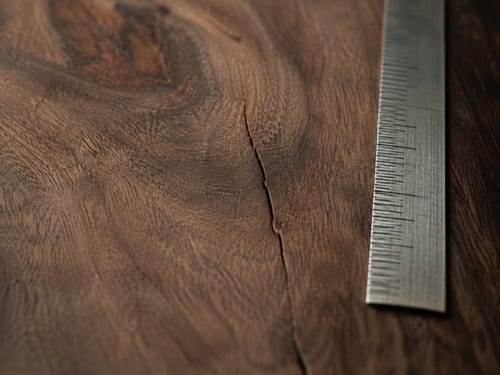
Moisture content is not like that. Wood that is too wet looks, feels and photographs exactly like wood that is correctly dried. The furniture passes inspection, ships, clears customs, and reaches a warehouse. Then, six to twelve weeks later, the complaints start: table tops with open joints, panels that have split along the grain, cracked lacquer, doors that no longer sit square.
By then the container is paid for, the goods are in customers’ homes, and the factory’s position is that everything was fine when it left.
Why it happens
Wood is hygroscopic — it constantly exchanges moisture with the air until it reaches equilibrium with its surroundings. As it gives up moisture it shrinks, and it shrinks unevenly: substantially across the grain, very little along it.
That is the whole problem in one sentence. Furniture made in Jodhpur in humid conditions and shipped to a centrally heated home in Denmark, Canada or Germany in winter is moving between two very different environments. If the timber was not dried to suit the destination, it will dry out after assembly — and a wide panel that shrinks while its frame does not is a split waiting to happen.
This is why the same design can perform perfectly in a humid market and fail repeatedly in a dry one. The furniture did not get worse. The destination changed.
What to specify
Target moisture content depends on where the furniture will live, not where it was made. As a general guide:
- Centrally heated interiors — Northern Europe, Canada, the northern US in winter — sit at the dry end. Specifications for these markets are typically tightened accordingly.
- Temperate and coastal markets tolerate a slightly higher figure.
- Ambient air-dried timber in an Indian workshop can sit well above either, especially during and after the monsoon.
Whatever number you choose, three things matter more than the number itself:
- Put it in the PO as a measurable tolerance, expressed as a range with a maximum — not “kiln dried”, which is a process claim, not a result.
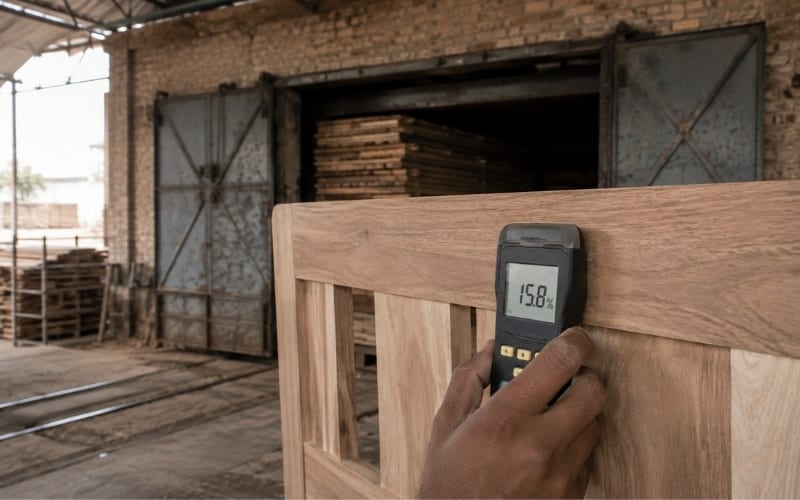
- Say where it is measured. Surface readings on a finished piece are close to meaningless; the surface equilibrates with the workshop within days. Readings must come from the thickest sections and, wherever possible, from the core.
- Say how many pieces. One reading on one leg is not evidence about a lot. Readings should be spread across units and across component types — tops, legs, aprons, panels — because they are often cut from different stock.
How it is actually measured
Two instrument types are used on site:
- Pin-type resistance meters drive two probes into the wood and measure electrical resistance. They read at the depth of the pins, which is what makes them useful — but they leave small holes, so they are used on unseen surfaces or on sacrificial pieces.
- Pinless capacitance meters read a zone beneath the surface without marking the piece. Non-destructive, and better suited to finished goods, but the reading is shallower and more sensitive to density and finish.
Both need to be species-corrected: dense sheesham and lighter mango do not read identically on the same setting. A meter used on the default setting for everything will give you numbers, but not facts.
What a moisture check should leave behind
A defensible record is not “MC checked — OK”. It is a table of readings: which unit, which component, which instrument, what species correction, what the specified range was, and photographs of the meter display against the piece. That record is what turns a later dispute from an argument into a document.
It also has a second life. Readings collected over several orders from the same supplier show whether the drying process is genuinely under control or whether you have simply been lucky with the season.
The seasonal trap
In India’s furniture clusters the monsoon is the risk window that catches new importers. Timber stored or worked in high humidity, then rushed through finishing to meet a shipping date, is the classic route to a container of splitting furniture. The furniture that leaves in that window can be flawless on the day and still fail three months later.
If your production overlaps a humid period, moisture content stops being a routine line item and becomes the check worth spending time on.
Qualis Assurance measures and records moisture content as part of pre-shipment inspection and monitors drying during production monitoring, when there is still time to do something about it.
1 September 2026
Materials & Defects
Why Solid Wood Dining Table Tops Crack and Joints Open (And How to Prevent It Before Shipment)
Cracks and opening joints in solid wood dining tables almost always trace back to one cause: wood that shipped too wet. Here's why it happens, and…
Read →
20 September 2026
Sourcing in India
The Complete Guide to Importing Furniture from India
India offers world-class hardwood furniture at hard-to-match prices — and import risks that stay invisible until the container arrives. This complete…
Read →
1 September 2026
Sourcing in India
Your first furniture order from Jodhpur: a checklist before you pay the deposit
Most first-order problems are decided before production starts. What to verify, specify and photograph while you still have leverage.
Read →Related on this site
The services and references behind this note.
Defects it catches
Also useful
Your next India order. Protected.
Confirmed within 2 hours. Report within 24 hours of inspection. Paid by buyers only — never by factories.
Book an inspection