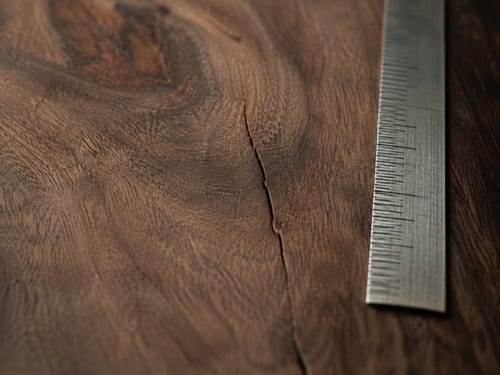
A solid wood dining table top arrives at your warehouse looking flawless. Six weeks later, a customer emails a photo: a hairline crack running the length of the top, or a seam where two boards have visibly pulled apart. The finish is perfect. The joinery looked clean on inspection. So what happened?
In the overwhelming majority of cases, the answer is the same, and it has almost nothing to do with craftsmanship. The wood was too wet when it shipped.
Wood moves. That is not a defect — until it is.
Solid timber is hygroscopic: it absorbs and releases moisture until it reaches equilibrium with the air around it. As it loses moisture, it shrinks — and it shrinks unevenly, far more across the grain than along it. A wide table top made of several boards glued edge to edge is essentially a panel under constant, invisible tension.
When a table is built and finished at one moisture level and then moves to a drier environment, that panel shrinks. If the movement is gradual and the wood was properly seasoned, the table absorbs it and nothing shows. If the wood shipped wet and then dries fast, the shrinkage outruns what the joints and the board can tolerate — and the tension resolves itself the only way it can: a crack across the top, or a joint opening along a glue line.
Why this hits imports from India especially hard
The problem is a moisture gap — the difference between the wood’s moisture content when it left the factory and the equilibrium it is forced to reach in the destination home. Two things make that gap wide for furniture imported from India:
- The destination is drier than the workshop. A heated home in Chicago, London or Berlin in winter can sit at 6–8% equilibrium moisture content. Furniture that left a workshop at 14–16% has a long, violent way to fall.
- Kiln time gets cut under deadline pressure. Properly drying dense hardwoods like sheesham (Indian rosewood) takes time and kiln capacity. When a vessel date looms, shortening or skipping the kiln cycle is the quiet shortcut — and the surface feels dry even when the core is still wet.
This is why the same table can pass a visual inspection and still fail in service. A crack that appears in January in a customer’s dining room was very often set in motion months earlier, by a moisture reading nobody took.
The specific failures, and what causes each
- End-grain checks and surface cracks: the top dries and shrinks faster than the wood can accommodate. Most common on wide single-slab or edge-glued tops.
- Joints opening along glue lines: adjacent boards shrink and the glue line becomes the weakest point. Often looks like poor gluing but is really wood movement the glue was never going to survive.
- Cupping and warping: uneven moisture loss between the top face and the underside, common when one side is sealed and the other is left raw.
- Breadboard ends splitting or protruding: the main panel shrinks across its width while the breadboard end stays put, so the ends no longer line up.
How it is actually prevented
You cannot fix wood movement after the fact, and you cannot see moisture with your eyes. Prevention comes down to one number, measured at the right moment: the moisture content of the finished pieces, before they are packed and shipped.
- Set a moisture target in your specification — as a number, not a wish. “Properly seasoned” means nothing in a contract. A clause like “moisture content ≤ 10% at pre-shipment inspection, core reading, pin meter” does.
- Match the target to the destination climate. Furniture bound for dry, heated markets (much of North America and Northern Europe) needs a lower shipping moisture content — typically 8–11% — than furniture staying in a humid climate.
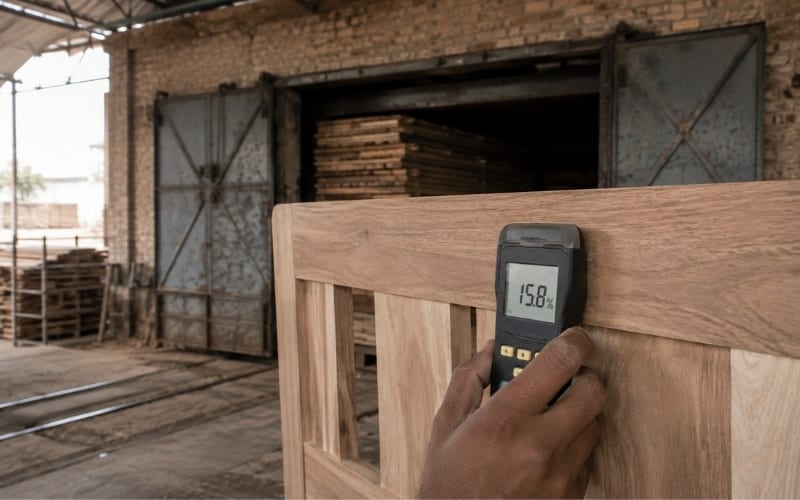
- Verify it with multiple readings per piece. A single surface reading can read dry while the core is wet. Readings should be taken at several points and depths across sampled pieces.
- Check it before payment, not after arrival. Once the container is sealed and the balance is paid, a cracked shipment is your loss to absorb.
Where a pre-shipment inspection catches it
Moisture content is the first thing checked in a proper furniture pre-shipment inspection. A pin-type meter takes multiple readings across sampled pieces, the results are reported as a range against the limit set for your destination, and anything above tolerance is flagged before the container is loaded — while there is still time to hold the shipment and dry the wood, rather than discovering the problem in a customer’s home.
It is a small check with an outsized payoff. Wood that ships at the right moisture content moves gently and stays whole. Wood that ships wet becomes a warranty claim you pay for twice — once in returns, and again in reviews.
Qualis Assurance is an independent furniture inspection company based in Jodhpur, India. We check moisture content, structure and finish on the ground before your container ships — paid by buyers, never by factories. Learn more about pre-shipment furniture inspection in India.
1 September 2026
Materials & Defects
Moisture content: the furniture defect that only shows up after your container lands
Sheesham and mango furniture can pass a visual inspection and still split six weeks later. Why moisture content has to be measured, not assumed.
Read →
20 September 2026
Sourcing in India
The Complete Guide to Importing Furniture from India
India offers world-class hardwood furniture at hard-to-match prices — and import risks that stay invisible until the container arrives. This complete…
Read →
1 September 2026
Sourcing in India
Your first furniture order from Jodhpur: a checklist before you pay the deposit
Most first-order problems are decided before production starts. What to verify, specify and photograph while you still have leverage.
Read →Related on this site
The services and references behind this note.
Defects it catches
Also useful
Your next India order. Protected.
Confirmed within 2 hours. Report within 24 hours of inspection. Paid by buyers only — never by factories.
Book an inspection