Joint and frame failure
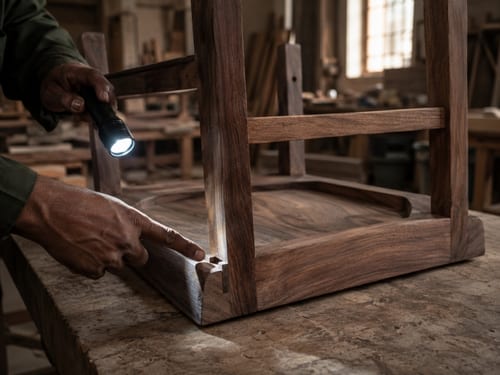
Subcontracted assembly with undersized tenons or missing corner blocks — invisible until a customer sits down.
Why it happens
Tenons cut undersized run through the machine faster and still fit the mortise. Corner blocks are the cheapest part of a chair and the easiest to leave out.
Assembly is one of the processes most often sent outside the main factory, so the joinery in your order may never have been made by the supplier you audited.
Nothing about it is visible once the piece is finished and packed. The failure arrives when a customer puts their weight on it.
How to specify against it
A defect you can name in the purchase order is a defect an inspector can fail the shipment on. One you only describe in an email is not.
- Name the joint. Specify the construction — mortise and tenon, dowel, corner block, bracket — for each load-bearing junction rather than leaving it to the factory.
- Reference a standard your retailer already tests to: EN 1728 and EN 12520 for seating, EN 12521 for tables.
- Require a during-production visit before upholstery or finishing closes the frame, because after that the joint cannot be inspected without destroying the piece.
- Ask where assembly actually happens, and get that address into the purchase order.
The inspection point
Each of these is a numbered check on a published scope, so you can see exactly which visit finds this and when.
Other defects in the library
Short shipment
DEF-047 · Quantity · Count
Cartons counted at the door, not the invoice. Orders arrive 5–20% short with no recourse after payment.
Wrong or missing hardware
DEF-053 · Hardware · Kit
Flat-pack kits with mismatched fittings turn a sellable SKU into a returns problem.
Container loading damage
DEF-061 · Loading · Stacking
Poor dunnage and stacking crush the bottom tier before the ship leaves Mundra.
Catch this one before it ships.
Confirmed within 2 hours. Report within 24 hours of inspection. Paid by buyers only — never by factories.
Book an inspection